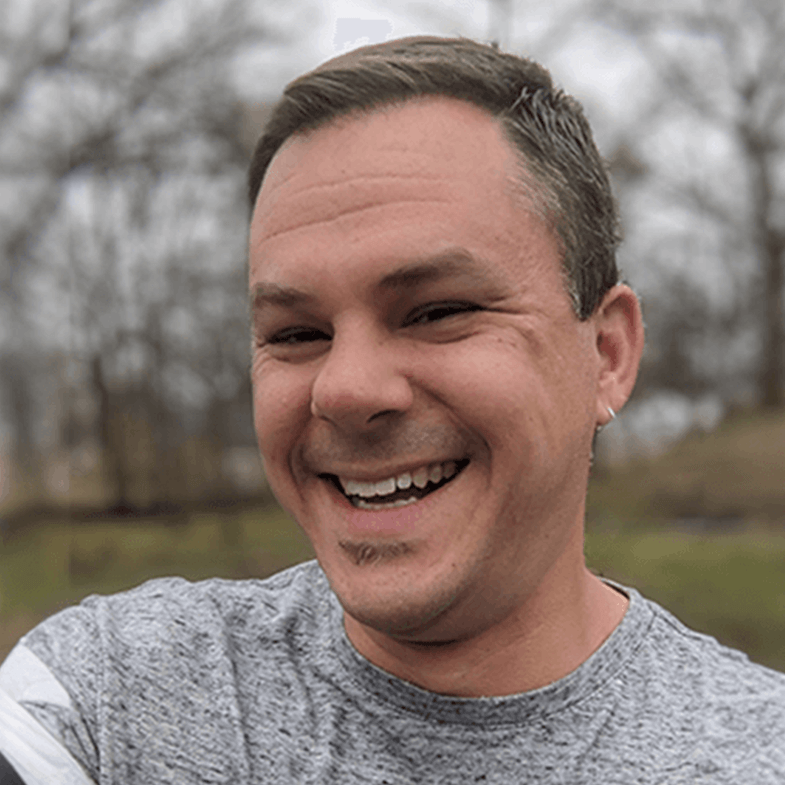
Jonathan Andrus, President & Founder
Company: Groundswell Saint Louis
Website: groundswellstl.org
Industry: Non-Profit
Stage: Early
Founded: 2024
This founder story explores how content gradually became a meaningful part of building Groundswell Saint Louis. Instead of starting with a clear strategy, the journey reflects what many founders experience—uncertainty, hesitation, and eventually, a shift driven by necessity.
Here are some of the many things you’ll learn in this story:
- When content started to matter in a real founder journey, and what triggered that shift.
- The challenges of translating a deeply personal vision into clear public messaging.
- How content supports trust and connection, especially before conversations even begin
- Why imperfect, consistent output often matters more than waiting for the “right” strategy.
When Jonathan Andrus started Groundswell Saint Louis in 2024, content wasn’t something he treated like a formal strategy. It was there, in the background, loosely tied to how he talked about the mission and invited people into it.
As a faith-based non-profit focused on building partnerships across the Greater St. Louis area, the work itself felt deeply relational. Conversations mattered more than campaigns. Trust was built face-to-face.
Content, in that context, felt both important and strangely undefined.
Jonathan knew it had a role to play, especially in helping people understand the vision. But early on, it came across more as an obligation than a clear lever for growth. Looking back, he sees that tension clearly. There was a desire to avoid anything that felt like advertising, but also a growing awareness that without visibility, the mission would struggle to expand.
That gap between belief in the work and the ability to communicate it clearly would shape his entire founder content journey.
The Early View on Content
In the beginning, content was mostly about vision casting.
Jonathan tried to humanize the mission by sharing parts of his own story. That felt natural. What didn’t feel natural was translating that into structured, public-facing content that could scale beyond one-on-one conversations.
Looking back, he sees a lot of the early material differently now. It sounded good on the surface (polished language, strong phrasing), but underneath, it lacked clarity. There were too many buzzwords and too many assumptions about what people already understood.
That assumption turned out to be one of the biggest blind spots.
“We thought we were speaking clearly,” he reflects, “but we were often using words that didn’t mean the same thing to the people reading them.”
There was also a familiar pattern: an early push to launch a website, and that became the centerpiece. Once it was live, it felt like a major milestone had been reached.
And then… things slowed down. No consistent follow-up. No evolving narrative. No ongoing effort to explain or refine the message.
Content didn’t disappear entirely, but it stopped evolving. It wasn’t yet part of an ongoing process.
When Content Started to Matter
The shift didn’t come from a single moment. It came from a growing realization.
Without accessible content, growth had limits.
Groundswell had a strong base of supporters, people who believed in the mission and were willing to engage. But that base wasn’t expanding fast enough to match the scale of the vision.
And the vision was big. It extended across the entire Greater St. Louis metro area.
That kind of reach doesn’t happen through conversations alone.
Jonathan still believes deeply in face-to-face interaction. It’s foundational to the work. But over time, it became clear that those conversations needed an entry point.
People were looking things up before engaging. They needed context before committing to a conversation.
Content wasn’t replacing relationships; it was enabling them. Without it, too many potential connections never even started.
The Friction Founders Face with Content
Even after that realization, execution didn’t get easier.
Jonathan is still running a lean organization. In many ways, he is the communications team.
There are volunteers. There’s support. But when it comes to shaping the voice of the organization, that responsibility sits with him.
And that brings a different kind of pressure.
It’s one thing to speak in a room. It’s another thing to publish something that represents the organization long-term.
Content doesn’t disappear after it’s shared. It stays. It gets revisited. It gets interpreted in ways you can’t control.
That permanence changes how you approach it. There’s also the challenge of translation.
Jonathan is comfortable casting vision in conversation. But turning that into clear, written communication that competes for attention online is a different skill.
And like most founders, he doesn’t have unlimited time to figure it out. So content becomes something that’s easy to delay.
The Turning Point
Jonathan subsequently observed that growth and capacity had stopped aligning. There was more the organization wanted to do. More impact it could have. But the network needed to support that growth wasn’t expanding at the same pace.
This situation forced a change in thinking.
He began working with fundraising coaches who understood both relationship-building and marketing. They pushed him to approach content differently. Not as something optional or secondary, but as part of how the organization grows.
The advice was simple: Stop waiting for when everything is refined; when you feel ready. Start publishing now!
It meant stepping outside his comfort zone. Letting go of the idea that content had to be perfect. Accepting that the only way to get better was to actually do the work.
That change from hesitation to action marked the real turning point.
How Content Changed the Business
The impact showed up faster than expected.
Within a few months of becoming more active and intentional with content, Groundswell started seeing new donors come in.
Some were already loosely connected to the organization. Others were entirely new.
The common thread was awareness.
People were hearing about the work. They were understanding it more clearly. And that made it easier for them to step in and support it.
It wasn’t the result of a perfectly crafted strategy. It was simply the result of showing up consistently enough to be seen and understood.
For Jonathan, that was surprising.
There’s a moment of realization in his reflection that feels almost understated: if you talk about what you’re doing, people might actually respond.
Content also reinforced something else: the connection between founder voice and company voice.
Right now, the two are closely linked. The organization’s message is largely carried through Jonathan’s perspective.
Over time, the goal is to broaden that voice. But in the early stage, that personal connection has been an asset, not a limitation.
It gives the mission clarity. It gives the message consistency.
The Lesson for Other Founders
If there’s one thing Jonathan believes founders misunderstand about content, it’s how much groundwork is required for people to truly understand what you’re saying.
The biggest issue isn’t always visibility. It’s clarity.
“We assume a shared vocabulary that doesn’t actually exist,” he explains. “We may be using the same words, but we often mean different things.”
That gap creates friction in ways that aren’t always obvious. It shows up in slow growth, confused conversations, and missed opportunities.
His one-line reflection captures the journey simply:
“You can actually do this.” Not perfectly. But consistently enough to learn, improve and make a difference.
And if you keep pushing content off, the cost is real. You’re building a ceiling over your own growth.
Closing
For Jonathan, content didn’t start as a strategy. It started as something unclear, slightly uncomfortable, and easy to postpone.
Over time, it became something much more practical.
A way to open doors to new relationships. A way to extend conversations beyond certain limitations. A way to help people understand what Groundswell is actually trying to do.
It’s still evolving. Still imperfect. Still in progress.
But it’s no longer optional. It’s part of how Groundswell shows up in the world and how it continues to grow.